
Toll-Free Contact: 877-333-1456 | Toll-Free Admissions: 647-716-1293

Toll-Free: 877-333-1456
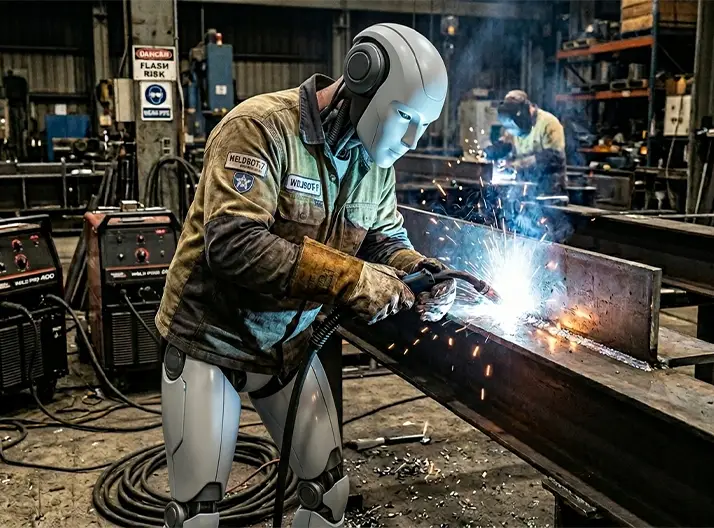
The question sounds simple: will robots replace welders?
The better answer is more realistic: robots will replace some repetitive welding tasks, but they are unlikely to replace the full range of human welding skills.
Welding automation is already part of modern manufacturing. Robotic welding systems are used in industries where parts are consistent, welds are repeated, and production speed matters. In the right environment, automation can improve consistency, productivity, and safety.
But welding is not always done in perfect conditions.
Many welding jobs happen in tight spaces, on repair projects, on construction sites, inside fabrication shops, around uneven materials, or in situations where the welder has to adjust based on what is actually in front of them. This is where human skill, judgment, and experience remain difficult to replace.
Myth 1: Robots Can Do All Welding Work
Robots are excellent at repeated work. If a manufacturer needs the same weld performed on the same type of part thousands of times, robotic welding can be a strong solution.
But that does not describe every welding job.
A robot works best when the material, position, joint fit up, programming, and work environment are controlled. If the part changes, the gap changes, the angle changes, or the environment is unpredictable, the welding task becomes more complex.
Human welders can observe, adjust, problem solve, and make decisions in real time.
That matters in field welding, repair work, custom fabrication, structural work, maintenance, and many industrial environments.
Myth 2: Welding Automation Means Welders Are No Longer Needed
Automation does not remove the need for welding knowledge. In many cases, it increases the need for people who understand welding.
Robotic welding systems still need trained people to set up jobs, understand weld quality, inspect results, troubleshoot problems, adjust parameters, and recognize defects. A robot can follow a programmed path, but someone has to understand whether the weld is acceptable.
This creates a new type of opportunity for welders.
The future may not only need welders who can weld manually. It may also need welders who understand machines, automation, weld quality, inspection standards, and process control.
This is why welding training still matters. The stronger a person’s foundation is, the easier it becomes to adapt to new tools and technologies.
Myth 3: AI Welding Will Make Human Judgment Unnecessary
AI can help welding in many ways. It may support monitoring, defect detection, production planning, equipment settings, or inspection systems. These tools can be useful, especially in advanced manufacturing.
But AI does not remove the need for human judgment.
A welder still needs to understand the job, the material, the process, the position, the safety risks, and the final quality expectation. Welding is not only about creating heat and joining metal. It is about making the right decision before, during, and after the weld.
For example, a welder may need to ask:
- Is the joint prepared properly?
- Is the material clean?
- Is the machine set correctly?
- Is the fit up acceptable?
- Is the welding position safe?
- Is ventilation adequate?
- Does the weld meet the expected quality?
- Should the work stop because something is wrong?
These are not just machine questions. They are trade judgment questions.
Where Robotic Welding Works Best
Robotic welding is most useful in controlled and repeatable environments.
This may include:
- Automotive manufacturing
- High volume production
- Repeated parts and assemblies
- Consistent fixtures and jigs
- Factory based fabrication
- Long production runs
- Jobs where speed and repeatability are important
In these settings, automation can support productivity and consistency. It can also reduce some repetitive or hazardous work for humans.
This is a positive development when used properly.
The welding industry should not see automation only as a threat. It can also create safer workplaces, better production systems, and new technical roles for people who understand welding.
Where Human Welders Remain Hard to Replace
Human welders are still difficult to replace in work that is variable, physical, custom, or judgment based.
This includes:
- Tight spaces
- Field welding
- Repair welding
- Custom fabrication
- Structural adjustments
- Jobsite welding
- Maintenance work
- Small batch production
- Material fit up challenges
- Weld inspection awareness
- Changing weather or site conditions
- Work that requires communication with other trades
In these situations, a welder is not just repeating a task. The welder is reading the job.
That is why the LinkedIn line is true: robots may repeat a weld, but welders read the job.
Welding Is Becoming More Technical
One of the biggest mistakes people make is thinking welding is only manual labour. Modern welding is technical.
A skilled welder may need to understand:
- MIG, TIG, Stick, and FCAW processes
- Machine settings and parameters
- Welding positions
- Joint preparation
- Blueprints and welding symbols
- Weld defects
- Metallurgy basics
- Heat control
- Safety and ventilation
- Qualification testing requirements
- Inspection expectations
This technical knowledge becomes even more important as automation grows.
A person who understands welding can work more confidently around new equipment, new tools, and new production systems. A person who only memorizes one technique may have a harder time adapting.
What This Means for New Welders
For new welders, the message is not to fear robots. The message is to build real skill.
Students should focus on learning the process, not just creating a weld bead. They should understand why machine settings matter, why preparation matters, why safety matters, and why different welding processes are used in different industries.
A job ready welder should also learn how to receive feedback, correct mistakes, and improve through practice.
Automation may change parts of the welding industry, but it does not remove the value of practical welding confidence. In fact, it can make strong fundamentals even more important.
The TopWeld Approach
At TopWeld, welding training focuses on hands on learning, process understanding, and practical confidence.
Students can build skills in MIG, TIG, Stick, and FCAW while learning in a professional training environment. For welders with experience qualification preparation can help them practice with more focus before testing.
TopWeld supports students across Brampton, Surrey, and Edmonton. Each location serves students in different regional labour markets, but the core goal remains the same: help welders develop practical skills that can support their long term career path.
The future of welding will not be only human or only robotic. It will likely be a mix of skilled welders, smarter tools, automated systems, and higher expectations.
That is why the best welders will not be the ones who ignore technology. They will be the ones who understand the trade well enough to work with it.
Final Thought
Robots can repeat a weld.
Human welders can read the job, understand the conditions, adjust technique, notice problems, and make decisions.
That difference matters.
The future of welding will reward people who are skilled, adaptable, safety aware, and willing to keep learning.
Looking to enter the welding industry?
Let’s get started.
Looking to enter the welding industry? Let’s get started.

Important Information for Candidates
- Welders are qualified, not certified
- Welder qualification testing is practical only; there are no written or theoretical exams
This information aims to ensure transparency and help candidates clearly understand the scope of welder qualification testing.