
Toll-Free Contact: 877-333-1456 | Toll-Free Admissions: 647-716-1293

Toll-Free: 877-333-1456
Before You Arrive: Check-In and Orientation
Most first days start the same way, regardless of school or province: check-in, paperwork, and a facility walkthrough. You’ll meet your instructor, get assigned a booth, and if your program supplies it, receive your PPE. This part takes longer than people expect, and that’s by design. Getting oriented properly matters more than getting to the torch quickly.
Safety Comes First
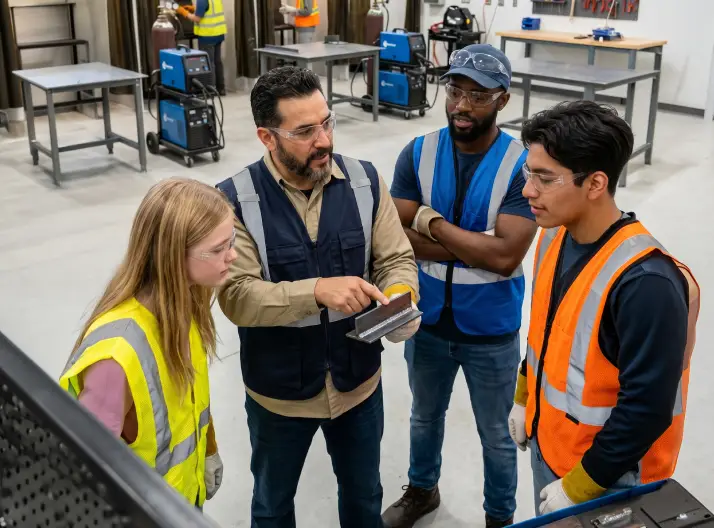
Every first class covers safety before anything else: PPE, proper ventilation, and how to set up your station correctly, all before you ever strike an arc. This isn’t a formality. Welding involves intense heat, UV light, and fumes, and the habits you build in week one are the ones that keep you safe for the rest of your career. Expect your instructor to check your PPE setup personally before you’re cleared to strike your first arc, not just explain it once and move on.
Learning Your Machine Before Your Technique
Next comes the equipment itself: how to read your machine’s settings, how to hold a consistent angle, and how to control your travel speed. Nobody expects a clean, uniform weld bead on day one. Most first classes spend more time on setup and control than on technique: precision comes later; control comes first.
What to Practice Before Day One
A few things help before you even walk in. Dress for it: no loose sleeves, no synthetic fabrics (they can melt), closed-toe boots are non-negotiable. Build the habit of scanning your work area before starting anything: knowing what’s hot, what can spark, and where your exits are. And go in expecting it to be loud, bright, and hot. That’s completely normal, not a sign something’s wrong.
MIG, TIG, Stick, or FCAW: Which Do You Learn First?
New students often ask which process to start with. There’s no universally “easiest” answer, but a few things generally hold true. MIG welding is the most common starting point for beginners: the equipment handles a lot of the consistency for you while you build fundamentals. TIG welding takes more hand-eye coordination and is usually easier to pick up after you already have MIG or Stick experience. Stick (SMAW) welding is valued for field and structural repair work and teaches arc control quickly, without shielding gas to manage. FCAW sits close to MIG in feel but is built for higher-deposit structural and heavy fabrication work. Most programs, including ours, introduce students to MIG, TIG, Stick, and Flux Core rather than specializing immediately, a broader foundation makes it easier to adapt once you’re on an actual job site.
Training vs. Qualification Testing: What’s the Difference?
It’s worth being clear on a distinction that trips up a lot of new students: welding training and welder qualification testing are not the same thing. Training builds your skill and technique over weeks or months. Qualification testing is a practical evaluation: in Canada, welders are qualified, not certified, and qualification testing itself is practical only, with no written or theoretical exam component.
Some students move directly from foundational training into qualification preparation once they’re ready; others train for a longer period first. Either path is normal, and a good training program should be transparent with you about which stage you’re actually in.
How Long Does It Take to Become a Certified Welder?
This varies by province, but the general structure is similar across Canada. Ontario’s Red Seal welder apprenticeship requires roughly 6,000 hours of combined on-the-job and in-school training, about three years (Skilled Trades Ontario). Alberta’s program is structured as three periods, each with 1,560 hours of work experience plus eight weeks of classroom instruction (Government of Alberta, Tradesecrets). Nationally, the harmonized Red Seal standard for welding totals approximately 5,400 hours across in-school and on-the-job training (Red Seal Program). Shorter, non-apprenticeship certificate programs (like an initial welding foundations course) take considerably less time, and are often the entry point before an apprenticeship begins. On pay: Government of Canada Job Bank data lists Canadian welder wages in a national range of $22.00 to $47.00 per hour, with a median of $30.00 per hour, varying by province, experience, and process specialization.
What to Bring and What’s Provided
Programs vary on exactly what’s supplied versus what you bring yourself, so it’s worth confirming before day one. At minimum, expect to need closed-toe leather boots and clothing that meets the no-synthetics rule; helmets, gloves, and other PPE are often provided or available to purchase through the school. Booth time is typically scheduled and shared, so expect a mix of hands-on practice, instructor demonstration, and observation, not unlimited solo torch time on day one.
How Progress Is Actually Measured
Welding is one of the few skills where you can see your own progress directly. Your first weld and your fifth weld will look visibly different, and a good instructor will show you exactly what changed and why: bead consistency, travel speed, angle control. That direct feedback loop is part of what makes the early weeks work: you’re not waiting for a test result to know if you’re improving, you’re looking at the weld in front of you.
Your First Class in Surrey, Edmonton & Brampton
At Topweld’s Surrey, Edmonton, and Brampton campuses, your first class looks the same regardless of location: orientation, safety, fundamentals, and an instructor who works with you at the booth. From there, your path into a provincial apprenticeship (through SkilledTradesBC, Alberta’s Apprenticeship and Industry Training system, or Skilled Trades Ontario) follows the structure specific to where you’re training.