
Toll-Free Contact: 877-333-1456 | Toll-Free Admissions: 647-716-1293

Toll-Free: 877-333-1456
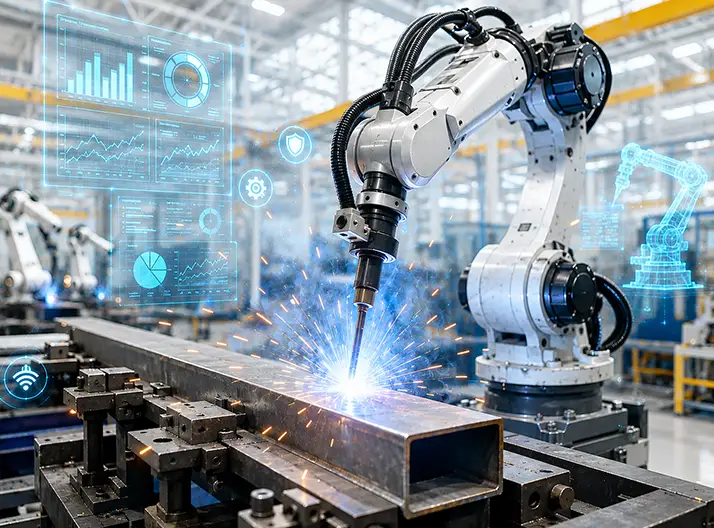
The New Career Question in the AI Economy
Artificial intelligence is changing the way people think about work. For years, many students and families believed the safest career path was an office based profession. A degree, a desk, a computer, and a corporate role were often seen as the default route to stability.
That conversation is changing. AI tools are now helping companies write, summarize, research, organize, calculate, design, respond, and automate many routine digital tasks. This does not mean office careers are disappearing. It does mean some entry level and repetitive office work may become more competitive, more compressed, and more technical.
In this new economy, skilled trades are gaining a different kind of value. Careers such as welding are not only physical. They require technical knowledge, safety awareness, problem solving, machine understanding, material knowledge, and real world execution. Those qualities are becoming more important, not less.
AI Is Changing What Employers Value
The World Economic Forum reports that advancements in AI and information processing are expected to transform businesses for 86% of employers by 2030. The same report also identifies analytical thinking as the most sought after core skill, with seven out of ten companies considering it essential in 2025.
That tells us something important. AI is not only replacing tasks. It is changing the value of human skills. Employers still need people who can think clearly, adapt, solve problems, communicate, and make decisions.
This is where skilled trades become highly relevant. A welder does not simply perform a routine action. A welder must understand the job, prepare the material, choose the right process, control heat, follow safety practices, read drawings, recognize defects, and adjust technique based on the work in front of them.
AI can support some parts of the workflow, but it cannot fully replace the human ability to work safely and effectively in changing physical environments.
Why Skilled Trades Are Becoming a Professional Advantage
The phrase blue collar career is often used too narrowly. It can make skilled trades sound less technical than they really are. In reality, many trades require a mix of technical skill, physical execution, judgement, safety knowledge, and continuous learning.
Welding is a strong example. A good welder needs to understand more than how to strike an arc. They need to know why machine settings matter, how materials behave, what weld defects look like, how joint preparation affects quality, how ventilation and PPE protect workers, and how drawings or symbols guide the work.
That is professional knowledge. It is practical, but it is still technical. It is hands on, but it still requires thinking.
In an AI economy, that combination becomes valuable. Careers that combine technical judgement with real world execution may be harder to automate fully because they require both knowledge and physical adaptability.
Office Work Is Not Disappearing, But It Is Changing
It would be misleading to say AI will remove office jobs. Many office based roles will continue to exist, and many will become stronger with AI support. However, AI is likely to change the starting point for many workers.
Tasks that once helped entry level workers learn the basics may be handled faster by software. Employers may expect new workers to bring stronger judgement, better communication, better technical comfort, and more independence earlier in their careers.
This creates pressure for students who are trying to choose a career path. They may ask whether the work they are studying for will still need people in the same way five or ten years from now.
That is why skilled trades are becoming more attractive. Trades are connected to physical infrastructure, manufacturing, repair, construction, fabrication, transportation, energy, and maintenance. These sectors still require trained people who can execute work safely and correctly in the real world.
Welding Is Execution Based Work
One of the biggest advantages of welding is that the work produces a visible result. A weld either meets expectations or it does not. The student can see progress, receive feedback, correct mistakes, and improve with practice.
This makes welding different from many abstract career paths. It gives students a direct relationship between training and skill development. Better preparation, better control, and better understanding often show up in the work itself.
For many learners, that is motivating. They are not only studying theory. They are building something, repairing something, or joining material that has a real purpose.
This execution based nature is one reason welding can hold value in the AI economy. A welding job may happen in a shop, on a site, in a tight space, on uneven material, or under changing conditions. These situations require judgement, coordination, and awareness.
Data Shows Skilled Trades Still Matter
Canada continues to show demand for skilled trades pathways. Statistics Canada describes the Registered Apprenticeship Information System as the main source of information on apprentices in Canada, and recent apprenticeship data has shown strong interest in trades training.
For welding specifically, Government of Canada Job Bank wage data lists Canadian welders as usually earning between $22.00 and $47.00 per hour, with a national median of $30.00 per hour. In Alberta, the listed median is $38.00 per hour, while British Columbia is listed at $35.00 per hour and Ontario at $28.00 per hour for the 2023 to 2024 reference period.
These numbers should not be treated as a job guarantee. Wages vary by province, region, employer, industry, experience, process skill, testing requirements, and work conditions. But they do show that welding remains a serious trade with measurable labour market value.
The Future Worker Will Need Both Skill and Adaptability
AI is not making skill less important. It is making adaptability more important.
For welders, this means learning the fundamentals properly. A welder who understands MIG, TIG, Stick, or FCAW only as a movement may struggle when conditions change. A welder who understands the process, settings, materials, positions, safety, and quality expectations is better prepared to adapt.
The future of skilled trades may include more digital tools, automated equipment, AI supported inspection, improved machines, and better training technology. But these tools still need people who understand the work.
The strongest workers will be those who are not afraid of technology, but also not dependent on it. They will be able to use tools while still applying real judgement.
What This Means for New Welders
For students considering welding, the message is simple: do not think of welding as only a fallback option. Think of it as a technical career path that can develop practical confidence and long term skill.
A new welder should focus on building a strong foundation. That includes safety, PPE, machine setup, welding positions, joint preparation, process selection, weld quality, drawing interpretation, and feedback based practice.
Students should also understand that one process is not the entire trade. MIG, TIG, Stick, and FCAW each have different uses. A broader understanding can help students make better decisions about career direction and training. The goal is not only to learn how to weld. The goal is to become a more prepared, more confident, and more adaptable welding learner.
TopWeld’s Role in Building Practical Career Value
At TopWeld, the focus is on hands on training, process understanding, and practical welding confidence. Students can build skills in MIG, TIG, Stick, and FCAW while learning in a professional training environment.
For students and experienced welders preparing for testing qualification preparation can help create a more focused practice path. This is especially useful for welders who want to improve consistency and understand what practical test readiness may require.
TopWeld offers training and qualification preparation across Brampton, Surrey, and Edmonton. Each location serves a different regional market, but the student need is often the same: practical training, clear instruction, facility access, and confidence building through real welding practice.
In an AI economy, that kind of hands on confidence matters. It gives students something they can carry into shops, job sites, fabrication settings, construction environments, repair work, and future learning opportunities.
Final Thought
AI is changing career value. It is compressing some tasks, raising expectations, and forcing students to think more carefully about what kind of skills will matter in the future.
Skilled trades are part of that future because they combine knowledge with execution. Welding is not only physical work. It is technical, safety driven, process based, and built through practice.
The future will reward people who can think, adapt, and work in the real world. That is why skilled trades are becoming a professional advantage.