
Toll-Free Contact: 877-333-1456 | Toll-Free Admissions: 647-716-1293

Toll-Free: 877-333-1456
What a Cobot Actually Does (and Doesn’t Do)
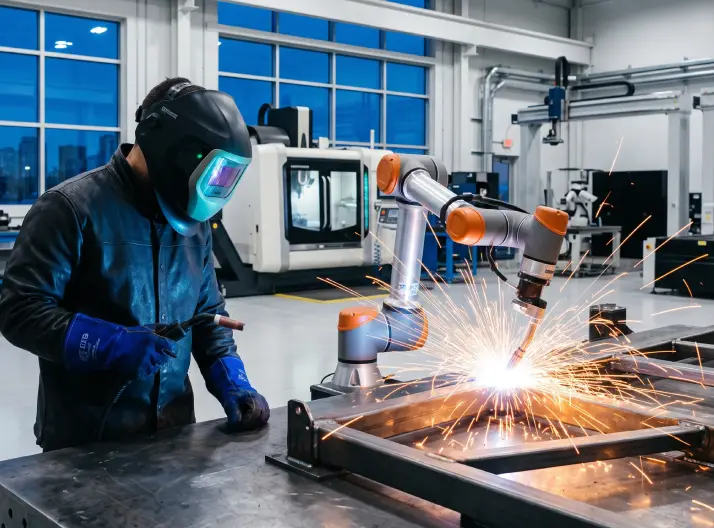
A cobot is a robotic arm designed to work alongside a human, typically automating repetitive weld paths once they’ve been programmed. Unlike a traditional industrial robot, which usually operates in a caged, isolated cell, a cobot is built to work safely in shared space with people, which is part of why it’s spreading into smaller fabrication shops that could never justify a full robotic welding cell.
What a cobot cannot do is decide where to weld, recognize when a joint is misaligned, sense when an arc is running too hot, or catch a weld that’s about to blow through. That judgment doesn’t come from code: it comes from years of reading a weld puddle. Programming a cobot is, in practice, teaching it to repeat a decision a skilled welder already knows how to make.
The Real Adoption Data
Despite the attention cobots get, Canada isn’t seeing a flood of installations. Canada ranks 13th globally in robot density, with 241 industrial robots per 10,000 manufacturing workers, well behind leaders like South Korea, which leads the world at over 1,000 per 10,000 workers (International Federation of Robotics, World Robotics Report 2025). More strikingly, robot installations in Canada actually fell 12% in 2025, down to 3,800 units. Most of what installation activity does exist is concentrated in the automotive sector, where it rises and falls with investment cycles rather than climbing steadily across manufacturing broadly. It’s worth sitting with that 12% decline for a moment. If cobots and industrial robots were genuinely displacing welders at scale, installation numbers would be climbing, not falling. The data points the opposite direction from the headline fear.
Who Actually Programs a Cobot?
Anthony Nighswander, founder of APT Manufacturing Solutions and one of the country’s leading FANUC integrators, made a point on the Weld Wednesday podcast that’s echoed across the industry: the best cobot programmers aren’t controls engineers. They’re welders: people who understand weld puddles, joint fit-up, and how metal actually behaves under heat. As more shops adopt cobots, many are finding they need more skilled welders to run them, not fewer.
That’s a meaningful signal for training. It means a controls or robotics background isn’t the fast track into cobot work: a strong manual welding foundation is. The technical side of programming a cobot is learnable on top of that foundation; the reverse, teaching weld judgment to someone who started in controls, is the harder path.
Where Cobots Are Actually Showing Up
In practice, cobot adoption in Canadian welding is concentrated in a few specific settings: automotive-adjacent fabrication, higher-volume production runs where the same weld repeats often, and shops large enough to justify the equipment cost. It’s far less common in field welding, custom fabrication, repair work, or small-batch production: the same categories where human judgment is hardest to replace in the first place. That distinction matters for career planning: cobots aren’t spreading evenly across the trade, they’re concentrated in a specific slice of it.
The New Skill Path: Cobot Operation as a Specialization
For welders interested in this direction, cobot programming is increasingly treated as a specialization layered on top of manual welding skill, not a replacement for it. That typically means learning basic robot programming or teach-pendant operation, understanding fixture and jig setup, and knowing how to troubleshoot a weld path when the automated result doesn’t match expectations: skills that build on, rather than bypass, a solid manual welding foundation.
What This Means for the Next Generation of Welders
The shops moving fastest on automation aren’t replacing their welding workforce: they’re hiring welders who can also run and troubleshoot the systems doing the work alongside them. That’s a different skill set than pure manual welding, but it’s built on the same foundation: understanding the process, not just the equipment. For a broader look at how AI and automation are affecting welding overall, we cover that separately below.
Should You Learn Cobot Programming Right Away?
For new students, the honest answer is: not first. Cobot operation is a specialization that sits on top of manual welding fundamentals: you need to understand weld quality, joint fit-up, and process selection before that knowledge is useful in an automated context. Employers hiring for cobot-adjacent roles are still looking for a manual welding foundation first; the automation piece is something you layer on once that base is solid, often on the job or through targeted upskilling later in your career.
Cobots in B.C., Alberta & Ontario Shops
This shift is already visible in fabrication shops across B.C., Alberta, and Ontario, including in Surrey, Edmonton, and Brampton, where cobot adoption is growing fastest in higher-volume manufacturing and automotive-adjacent fabrication work. Brampton’s manufacturing base gives it the highest concentration of this kind of activity of the three regions; Surrey and Edmonton see it more selectively, in larger fabrication and industrial shops rather than as an industry-wide standard.