
Toll-Free Contact: 877-333-1456 | Toll-Free Admissions: 647-716-1293

Toll-Free: 877-333-1456
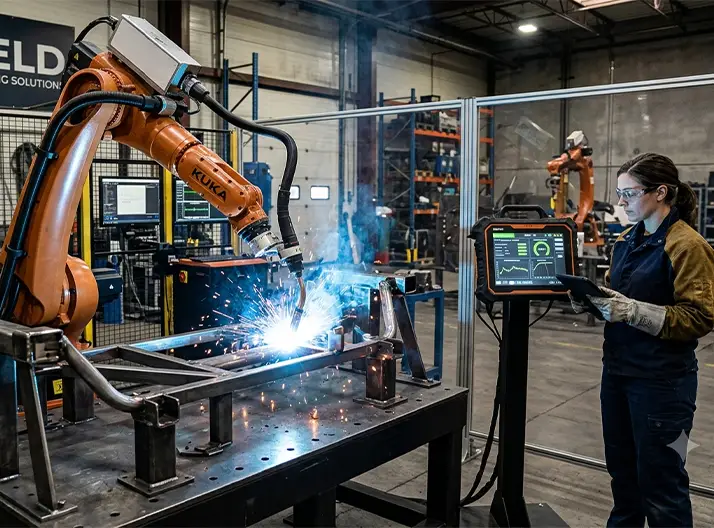
Artificial intelligence is changing the way industries plan, design, inspect, and produce work. Welding is part of this shift, but the future of welding is not as simple as machines replacing people. In many areas, AI and automation will support welders by improving productivity, quality control, training, and inspection. At the same time, skilled human welders will continue to matter because welding requires judgment, safety awareness, adaptability, and real world problem solving.
AI Is Changing Work, Not Ending Work
The AI economy is creating real concern, but the best available labour market research points to transformation rather than simple elimination. The World Economic Forum’s Future of Jobs Report 2025 projects that job disruption will affect the equivalent of 22% of jobs by 2030. The same report also projects 170 million new roles and 92 million displaced roles, creating a net increase of 78 million jobs. For welding, this means the conversation should not be framed as “AI versus welders.” A better question is: what skills will help welders work confidently in a more automated and data driven industry?
Where AI and Automation Already Support Welding
AI and automation can support welding in several ways. Robotic welding can help with repetitive production welds. Digital welding machines can support more consistent parameters. Sensors and imaging tools can assist with inspection and quality tracking. Software can help plan production, identify defects, and improve documentation. These tools are valuable, especially in manufacturing environments where the same weld is repeated many times. However, they still depend on trained people to set up equipment, understand the material, monitor quality, and respond when conditions change.
Why Skilled Welders Still Matter
Welding is physical, technical, and situational. A welder may need to adjust for fit up, joint preparation, heat distortion, material thickness, position, accessibility, weather, safety hazards, and inspection requirements. These are not always predictable from a screen. In field welding, repair work, custom fabrication, construction, and tight access environments, human judgment remains a major part of quality work. A robot may repeat a weld, but a skilled welder reads the job, understands the risk, and adjusts based on what is actually happening in front of them.
Canada Still Needs Skilled Tradespeople
Canadian labour market data supports the importance of skilled trades. Job Bank lists the national wage range for welders at $22.00 to $47.00 per hour, with a median wage of $30.00 per hour. Alberta shows a higher median wage of $38.00 per hour. Job Bank also reports a moderate risk of shortage for production welders from 2024 to 2033, with 90,900 workers employed in 2023 and 26% of workers aged 50 and over. These numbers show that welding remains connected to long term workforce needs, especially as older workers retire and industries continue to require skilled labour.
The Skills Future Welders Should Build
Future ready welders should focus on more than one process. MIG, TIG, STICK, and FCAW each have different applications across shop, field, manufacturing, repair, and fabrication work. New welders should also build confidence with safety procedures, basic drawings, measurement, joint preparation, welding positions, defect awareness, and testing expectations. In an AI driven economy, the strongest welders will be the ones who combine hands on ability with technical awareness and the willingness to keep learning.
What This Means for New Welding Students
For students, the rise of AI should not be viewed only as a threat. It should be seen as a reason to build strong practical foundations. Machines can assist with parts of the work, but they do not replace the need to understand heat, metal, movement, safety, and quality. Students who train seriously, practice consistently, and understand the standards expected in the industry will be better prepared for the modern welding environment.
How TopWeld Supports Skill Development
TopWeld supports students and experienced welders through hands on welding training, process focused learning, and qualification preparation. Training is available at TopWeld locations in Brampton, Surrey, and Edmonton. The goal is to help welders build practical confidence, understand process expectations, and prepare for real welding environments without relying on unrealistic promises about job outcomes.